How We Define “Done Right” With Job Forms
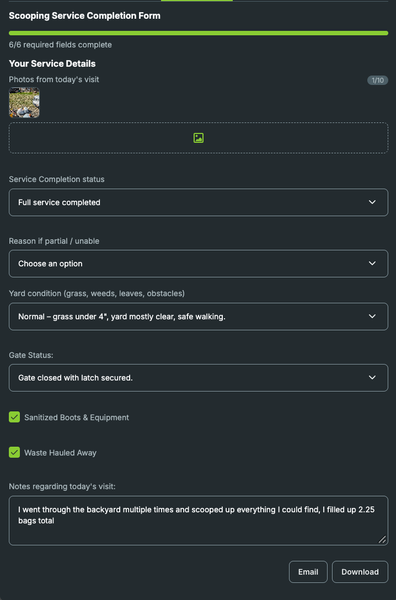
As we added technicians, I realized “do a good job” is way too vague. What does that actually mean? For us, it means things like checking the gate, following the right yard pattern, documenting anything unusual, making sure the area was actually completed, and leaving the property secure. The more of that we can put into Job Forms, the less we have to rely on someone remembering every detail from training. That matters even more when someone is new, covering another route, or just having an off day. I still think training and judgment matter. A checklist can’t replace a good technician. But it can protect the standard. The goal is that “done right” looks the same no matter who is on the route that day. What are the non-negotiables you’ve built into your Job Forms?16Views1like0CommentsThe Customer Notes That Protect Our Technicians
One of the simplest ways we use Jobber is also one of the most important. Customer notes and instructions on jobs. We document things like: gate instructions and what side of the house the gate is on How many dogs they have dogs that need to be secured aggressive dog history property quirks access issues areas to avoid anything that could affect how the technician enters or completes the job If multiple people need to receive the "On The Way" message That information matters a lot more once the owner isn’t the one servicing every property. I’ve had situations where employees were put in unsafe environments because a customer didn’t properly secure a dog. I’ve also been bitten myself. So I don’t want safety information living in someone’s memory or buried in a text thread. If a technician is going to a property, they should be able to open the job and know what they’re walking into before they ever open the gate. That protects the employee, the customer, and the business. What do other owners document in customer notes that your team absolutely needs before arriving on site?198Views0likes9CommentsChatGPT Integration - what information is shared and retained by Jobber
I see a lot of potential in connecting Jobber with ChatGPT and Claude, but I have questions about what information is shared and what happens to it afterward. At our company, I’ve spent about a year and a half using ChatGPT for brainstorming, branding, planning, and developing our business processes. Some of those conversations contain sensitive business details or ideas we’re still working through. I recently disconnected the Chatgpt integration while I look into this. Jobber Support confirmed that the ChatGPT connection cannot be limited to one project. The connection notice also says relevant chats and memories may be shared. Here’s what I’m trying to understand: What exactly does Jobber receive when we use the connection? Can we review what is being sent and choose what to leave out? Where is that information stored, and how long is it kept? Who can see it, including our team, Jobber staff, and outside providers? Can information received through one AI connection become available to another AI tool or feature? Could our business processes be used to improve Jobber or develop suggestions for other businesses, even with our identifying details removed? If we disconnect, what information remains, and can we have it deleted? I’ve read the help articles, Privacy Policy, and Terms of Service. They explain some things, but I haven’t found clear answers to these questions. Has anyone else looked into this? I’d appreciate hearing from other users and someone on Jobber’s technical or privacy team. I want to use these tools. I also need to understand what we’re agreeing to share and what control we have over it.35Views0likes0CommentsShould you stop serving neighborhoods that don’t produce route density?
I had to make this decision in my own business. Early on, I said yes to customers 35–45 minutes outside our core area because I wanted the revenue, reviews, and growth. Over time, those accounts became expensive in ways that didn’t show up on the invoice. More windshield time, more miles, fewer stops per hour, and harder routes for the team. We eventually started looking at which cities were producing our best customers and tightened our advertising around those areas. I also had to let go of an original client who had been with us for more than 4 years because she was simply too far outside where the business had grown. That wasn’t an easy conversation. But a $100 monthly customer can look very different financially when they require a 30-minute detour every visit. Revenue alone doesn’t tell you whether an area is worth serving. At what point do you stop advertising to an area or let existing outlier customers go?437Views2likes13Comments
How do you enter warranty jobs in Jobber?
We are a generator company and sometimes have warranty jobs that we need to track and bill to our vendors. What's the best practice for this? Should we create an account under our vendors name and then tie the job back to properties? Or maybe through job tags? But then that would show the payment coming from the customer and being applied to their account, no? Need to brainstorm this with someone, please.128Views1like2CommentsAre you building policies from fear or from experience?
A lot of our policies were written after something went wrong. I’ve been bitten by dogs twice. I’ve also had employees put in unsafe situations because a client was negligent about securing their dog. At some point, you stop treating those situations as one-offs. We now have much firmer rules around aggressive dogs, access, and when a technician leaves a property. If a dog is acting aggressively, we leave. If the customer can’t confirm an aggressive dog is secured, we don’t enter. I’ve had to fire clients over it. That’s where I think policies get tricky. You don’t want one bad experience to make the business rigid about everything. But when the same risk keeps showing up, protecting the team has to come before avoiding an uncomfortable conversation with the customer. Good policies should come from patterns, not panic. What policy in your business exists because you learned the lesson the hard way?34Views0likes0Comments
Fix the Plumbing Before Adding AI
Greetings Community 👋🏿 A concept I’ve thought about a lot: automating a broken workflow doesn’t save time, it just makes the mess move faster. A lot of teams jump straight to automation and the newest AI tools while the systems underneath are already disconnected: scattered user records, inconsistent permissions, duplicate data, and no clear source of truth. Identity is one of the best places to start. A well-managed IdP gives you a central place to manage users, access, and the SaaS applications your business depends on. It makes implementing SSO, provisioning, and deprovisioning across applications cleaner while establishing clear ownership of identity and access. Now you have a cleaner foundation to connect systems and build automations that actually make sense. Otherwise, you’re just automating the mess.284Views2likes6CommentsIs “being nice” making your business weaker?
This one can be hard to admit. A lot of service business owners start out wanting to be fair, flexible, and easy to work with. Then slowly, “being nice” turns into saying yes to things that hurt the business. Free extras. Late-night replies. Discounts that were never planned. Custom scheduling for one customer. Skipping fees because the conversation feels awkward. Letting a customer ignore policies because you don’t want conflict. I’ve done versions of this in my own business. At the time, it feels like good customer service. Later, you realize you trained the customer that your boundaries are optional. There’s a difference between being kind and being unclear. Kindness means communicating respectfully, fixing real mistakes, and treating people well. Poor leadership is letting customers, employees, or awkward situations pull the business away from its standards. That eventually affects the team, the route, the profit, and the customers who do respect the process. Where have you had to stop being “nice” and start being clearer?101Views0likes2Comments