Financial Dashboarding
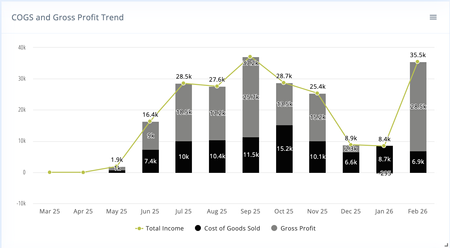
Hello! Thought I would share a useful tool our landscaping irrigation company started using recently. I am one of the co-owners of our business and handle all the accounting. Being in the industry for a while, I have found that many small companies struggle making financially-informed business decisions. I think the cause is that business owners may feel lost when looking at their books/margins/KPIs. I recently stumbled upon a tool called Reach Reporting which does financial dashboarding. You can connect it to Quickbooks or other major accounting softwares. It pulls all relevant financial data from your books and then gives you the ability to create your own financial dashboard or even has templates already made. It has been incredibly helpful for us to see our financials beyond a Balance Sheet and P&L. It slices, dices, graphs, and plots anything you want it to. This has helped other owners or managers in our company who do not have a financial background to understand our financials more clearly than ever before. This is just one of many examples. Hope you find it useful!5Views1like1CommentHow Much Should You Really Be Charging?
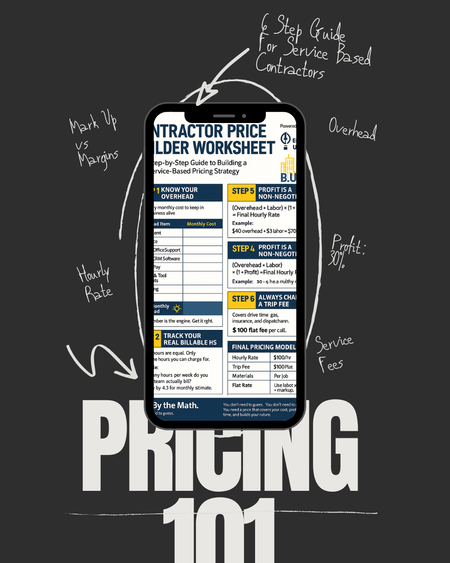
The number one question I receive is tied directly to the fact, most contractors are still guessing when it comes to pricing. Overhead. Profit. Labor rate. Trip fees. They think just because they throw a number they hear their competitors use, thats all that they need. It may work, but how and what do you divide these funds is just as important for your business health. If you don’t know how to do the math, you’re not building a business. You’re surviving check to check and think you need more work, when you do not. So here’s the plan: This Tuesday & Thursday on IG, I’m walking you through our Contractor Price Builder Worksheet FREE on instagram live. We will cover: - How to calculate your real hourly rate - The difference between markup and margin - Why profit is a non-negotiable - And how to price with confidence Join the session. Bring your numbers.832Views3likes22CommentsShould service businesses use debt to grow and scale, or stay debt-free?
How do you view using credit lines, vendor lines of credit, credit cards, and loans to grow your business? If you prefer to grow debt free what is your strategy? What do you think are the pros and cons of each?217Views1like6CommentsWhat do I need to know/have prepared in order to get better business loans?
Have been using Jobber Capital for years to help grow my business. However, it is expensive and really sucks for cash flow purposes. At least in my experience. Is there a better way to do that, or should I be trying to get financing somewhere else that is cheaper? If you recommend the Jobber Capital/ Stripe Loan, then how much have you taken? I have been approved for a little over $100K but I haven't wanted to take that risk. Let me know what you have done and options I may not be thinking of. Thanks!22Views0likes0CommentsHow can I create an invoice for the deposit?
When doing certain commercial work the client will ask us to send them an invoice for the deposit. This isn't typically how Jobber works as the invoice isn't created until the job is closed usually. What is the best way to send a customer an invoice before having the quote signed, deposit paid, or the job completed? Hope that makes sense. Thanks in advance!77Views0likes2CommentsHow do you scale past $1 Million in revenue? What are some common bottle necks to avoid?
Scaling past $1 Million has been one of the biggest challenges for me as a business owner. I'm curious what steps did you take to get over that hump and what advice do you have to get there?390Views1like16CommentsIn house financing. Jobber Payment Schedule.
I love that Jobber has implemented a payment schedule. I was just curious if anyone has considered using this feature to offer in house financing? Could you do batch invoicing for payments that are due? What do you think the pros and cons of that would be. Look forward to hearing some thoughts on this. Ps. We currently use Wisetack for customer financing.48Views0likes0CommentsCrypto as a form of payment?
I am not huge into crypto currency; however, I like the idea of diversifying my approach to my business and preparing myself for what could come. Are any of you accepting crypto as a form of payment? If so, then how do you go about that? Also what are your overall thoughts on it?98Views1like2CommentsWhy Every Service Contractor Needs to Understand Material Markup (Not Just Job Markup)
Some home service contractors love to mark up the entire job, and that’s fine until you realize you’re not really making money on your materials. For me, personally I love to know ow everything is divided in my margins... Because It covers all the costs that get overlooked: Warranty replacements that eat into profits Time to grab, stock, or return parts Fuel and vehicle wear from sourcing Credit card fees and supply chain risk When you don’t separate material markup, you lose visibility. If you’re inefficient in your labor or your jobs start dragging, you won’t know where the leak is. Understanding markup on material is one of the most vital fundamentals for any service provider. It’s what separates a day to day contractor from a profitable one. That’s why we built this quick resource for you: It breaks down: ✅ How to calculate markup by cost range ✅ What markup really covers (overhead, risk, and time) ✅ Why materials should always be treated as a profit center, not just a pass-through expense Download the worksheet, walk through it with your team, and start identifying where your leaks are. Let me know what you think.118Views1like2CommentsReal Reason Most Contractors Don’t Know Where the Leak Is (How to Price)
Just returned from the Masters of Home Service Podcast with Adam and we broke down something every contractors pain point... Most of us think our pricing problem is about charging more. But in reality, it’s about not knowing where the leak is. That’s why I built the Pricing Blueprint Worksheet, it forces you to look at every category inside your business: Is your hourly cost set right? Is your team milking jobs or burning hours? Is your overhead eating too much of your margin? Are your profit targets too low? Or are you just lost trying to figure out where it all goes? When you separate these categories, you finally see where your money ends up. You’ll know if it’s a labor problem, an overhead problem, or a leadership problem. This is exactly what we talked about on the podcast, that transition from employee mindset to owner mindset. Thank you Jobber Team for the opportunity. Here is the sheet we went over and let me know your thoughts.76Views1like2Comments