Progress Payments
I’ve been running into something with Jobber that I’m curious if other contractors are struggling with too. Jobber seems mainly designed around industries like pest control or lawn maintenance — companies that don’t usually run really high line item prices or multi-stage projects off a single quote. For trades like mine (electrical contracting), projects are often big and spread out — think full home rewires, panel changes with remodels, or multi-phase installs. On those kinds of jobs, you can’t realistically bill everything upfront. We need to take progress payments as the work moves along. Here’s what I’ve been forced to do: Create a quote for the full project and get the client to approve it. Save the quote, don’t schedule it. Start the job and then build separate invoices for progress payments. The problem is that this really messes with the books. Jobber ends up showing the full approved quote plus all the separate invoices and payments. That doubles the client value and makes reporting messy. It also makes it harder to show the client a clear record of what’s been billed versus what’s left. My idea for a fix: Add a “progress payment” option to quotes/jobs/invoices — basically the same way deposits work now. On a quote or job, we could set a deposit, and then later go back in and log progress payments against the total without closing the job. That way the system would track everything cleanly, clients could pay stage-by-stage, and we wouldn’t have to hack around the software to make it work. Also while I’m at it — one other small request: on desktop we can add text-only line items to quotes, which is amazing for breaking them into sections or adding explanations. On mobile, we can’t. It would be a huge time-saver if that feature was available in the app, too. So — is anyone else having this problem with progress payments in Jobber? Would this kind of solution help your business too? – TJ Maddock Odinson Electric, LLC483Views1like5CommentsAnyone else realize they were breaking even or losing money after expenses?
I had a phase where we looked “busy” on paper, fully booked, money coming in, but when I actually broke down the numbers, some jobs were barely breaking even. Once I factored in true payroll burden (taxes, workers comp), supplies, insurance, and transaction fees, it was a wake-up call. There were jobs we were doing that felt productive day-to-day but weren’t contributing to profit at all. For us, it came down to tightening up pricing, being more intentional about which jobs we accepted, and really understanding our numbers on a per-job basis (not just overall revenue). Curious if anyone else has gone through this and what changes made the biggest impact for you?392Views2likes7CommentsBudgeting for 2027 - Why I Build a Budget Every Year (Even After a Year I Didn't Stick to It)
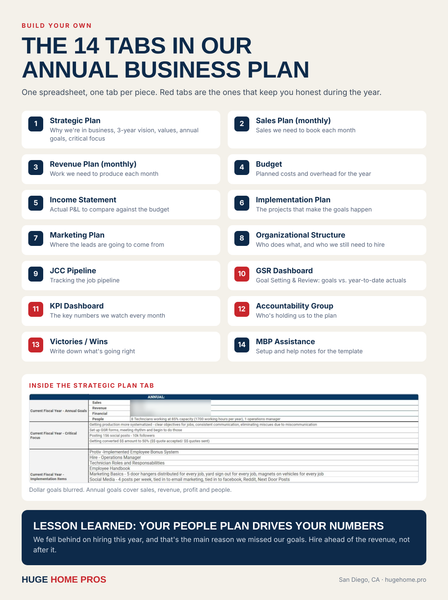
Every November I start building next year's plan. It's when I step out of the day-to-day and decide where the business is going instead of just reacting to whatever lands on my desk. I'll be upfront: this year I didn't really stick to my budget, and we didn't hit any of our numbers. The reason was hiring. I got behind on bringing people on, and the revenue never had a chance. What I learned is that your revenue goal is really a staffing goal in disguise. If the plan says you'll produce a certain amount of work, it assumes a certain number of people in the field doing it. When the people don't show up on schedule, neither does the revenue, no matter how good the sales and marketing side looks. I treated hiring like something I'd get to once we were busy enough. It should have been a line item with dates on it, right next to the months it was supposed to support. My plan lives in one spreadsheet with a tab for each piece (I've attached a graphic with all 14 if you want to build your own). It starts with the why, a 3-year vision and our values, then four annual goals: sales, revenue, net profit and people. From there it breaks into monthly sales and revenue plans, a budget, an income statement, marketing, org structure and the projects that make it all happen. The last tabs are the ones that keep you honest: a goals vs. actuals dashboard, KPIs, an accountability group and a list of wins. If you're building your budget right now, here's what I'd tell you: - Make it realistic. Build from what you actually did last year, not what you hope to do. - Tie every number to a plan. If revenue goes up, what has to be true? More crew, more leads, a better close rate? Give those deadlines. - Hire ahead of the revenue. Finding and training good people takes longer than you think. - Review it every month. That's the part I let slip this year. - Have someone hold you to it, whether it's a coach, a peer group or a partner. Missing our numbers wasn't fun, but it showed me exactly where the plan broke. This year I'm building it with the people side front and center. When do you start planning for next year, and what do you build your budget around?58Views1like1CommentWhich metric(s) do you check first to see how business is going? 🤓
There are plenty of numbers to track, but I’m guessing most business owners have one or two they keep a close eye on. 👍 Which do you check first? Vote in the polls below. Don’t see yours, or want to share why it matters? Drop it in the comments! In this Masters of Home Service episode, kasyallen (Wheatley Creek Services) shares which business metrics matter for home service businesses, why checking them regularly can help catch problems early, and how she built an automated end-of-day report to make the numbers easier to keep up with. 👉 Want to put their tips into action? Download our free home service reporting playbook for this episode. Never miss an episode of Masters of Home Service. Subscribe on Apple, Spotify, or wherever you get your podcasts. 137Views0likes1Comment
Are You Building a Business or Just Creating Yourself Another Job?
It’s easy as a small business owner to get caught up doing everything yourself. At what point do you start delegating, hiring, or putting systems in place so the business can operate without you being involved in every job? I’d love to hear how other owners are making that transition while still keeping quality and customer service high.324Views1like5Comments
Any Recommendations for SBA Lenders?
I’m curious whether anyone here has successfully used an SBA loan, grant, or other government-backed funding program for a very small business. I run a one-person metal art and fabrication business, and finding realistic financing has been difficult. A lot of the options marketed toward small businesses seem to come with high interest rates, aggressive repayment terms, or daily and weekly withdrawals that can make an existing cash-flow problem even worse. I’d be interested in hearing from anyone who has actually gone through the SBA process: Which loan or grant program did you use? Was the application process manageable? What documentation did they require? Did the funding genuinely help your business grow? Were there any fees, repayment terms, or surprises you wish you had known about beforehand? I’m especially interested in options that might work for a one-person business looking to purchase equipment, improve production capacity, or create more stable cash flow without getting trapped in predatory financing. Has anyone found an SBA lender, grant program, or small-business resource they would genuinely recommend? Thanks in advance, I am located in Northeast Pennsylvania.127Views0likes1CommentWould you fire a difficult customer even if they spend a lot?
I have this one custome who is very very supportive of what I do but can be very difficult ALL THE TIME, even when I do every thing the way he likes it its never up to par and there's always something thats wrong. It can be difficult at times specially when Im pressed for time and have other customers waitingSolved444Views1like12CommentsValuing a Trades Business — What's Your Experience?
I've been having some conversations lately about what a small trades company is actually worth — and I'm getting different answers depending on who I talk to. Some people say 1x annual gross revenue is the standard for a well-run trades business. Others say it's more like 2–4x EBITDA (net operating profit). And for a breakeven company with good employees and solid clients but no retained earnings, both methods produce very different numbers. A few questions for the group: Has anyone here bought or sold a trades business — or seriously explored it? What valuation method did you actually end up using? How much does systemization affect the number in your opinion? Does a business running on Jobber with SOPs, long-term employees, and documented processes command a premium over an owner-operated shop where everything lives in the owner's head? If you were bringing a friend or colleague into your business as a part-owner — someone who brings clients, crew, and vehicles — how would you structure that deal fairly for both sides? Would love to hear from anyone who's been through this — buyers, sellers, or people who've taken on a partner. This stuff doesn't get talked about enough in the trades.205Views1like3Comments
What do you do when a customer goes radio silence when their bill is due?
Does anyone have any advice on how to handle a customer who has gone radio silent without paying their bill? We finished the project and had a few punch list items to finish. The homeowner is not returning my calls to schedule the return date and they have an outstanding balance. This is a new issue for us so we feel a little unsure how to proceed. We'd love some ideas!322Views0likes5CommentsPayment Nightmare: Should Contractors Require a Deposit Before Starting a Job?
I recently had a job where the customer tried to pay in various formats and payment was never able to go through. I ended up leaving and hoping they would pay at a later date. Thankfully they did pay a few days later. How do others go about this potential issue? I have thought it may be a good idea to require a small deposit to make sure payment is able to be made before the job is started.647Views2likes14Comments