Workflow
We service appliances. We get a request through our website and then convert it to a job or we add it manually. Then we go out and diagnose them for a $95-$150 service call, depending on distance. If possible we repair then. If not we send over a quote, then once approved we turn it into another job and schedule it for repair. We end up with two separate jobs, instead of being able to approve the quote and add it to an existing job with a new scheduled job. Is there an easier way to do this that I’m missing?80Views1like4Comments
House call pro vs jobber
Is anyone else frustrated with Jobber's employee permissions and starting to wonder if Housecall Pro is pulling ahead? As a growing electrical service company, one of our biggest frustrations is not having enough control over what our field technicians can see within Jobber. We should be able to decide exactly what employees have access to, especially when it comes to pricing, financial information, customer records, and other sensitive business information. Here's what really doesn't make sense to me: We've spoken with Jobber customer support, and they've told us that even their own support employees have restrictions on what they can access or view within Jobber. So let me ask Jobber's developers and leadership a question: If Jobber limits what its own employees can see within its systems, why aren't business owners given that same level of control over what our employees can see? Jobber clearly understands the importance of restricting access to information. Why shouldn't the contractors paying for the software have similar flexibility? Housecall Pro appears to be ahead when it comes to employee permission structures, and with AI integrations and automation advancing, the competition is only getting stronger. Then there's employee pricing. As businesses grow and add more field technicians, these costs add up quickly. My questions for Jobber and this community are: Why can't business owners customize employee permissions more precisely? Does Jobber give its own internal employees unrestricted access to sensitive company information? If not, why should our field technicians have broader access than necessary? Is Jobber planning to improve employee permissions and pricing to compete with Housecall Pro? With AI integrations becoming more advanced, is Jobber investing in these capabilities fast enough? For contractors who have switched from Jobber to Housecall Pro, was it worth it? We've invested significant time and money into Jobber, and we don't necessarily want to switch. But we're getting to the point where we need to decide whether Jobber is going to evolve with growing service companies or whether it's time to move to Housecall Pro. We're not asking for anything unreasonable. We're asking for the ability to control our own business information and decide what our employees need to see to perform their jobs. I'd genuinely like to hear from other business owners managing multiple technicians. Are you experiencing the same frustrations? And I'd really appreciate a direct response from Jobber's development team on whether more granular employee permissions are actually on the roadmap.19Views0likes2CommentsMissed call / Auto text back AI agent
I see a lot of people have these set up with High Level. Is this a game changer do I need this? I do have a human admin that takes all our calls during the day, but sometimes she's already on that line or she's busy, and we miss the odd call. Just thinking I should probably set this up. Looking for some feedback. Thanks a lot.478Views1like10CommentsHow We Define “Done Right” With Job Forms
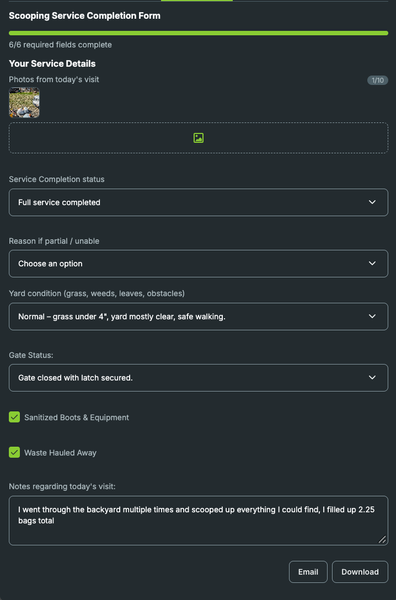
As we added technicians, I realized “do a good job” is way too vague. What does that actually mean? For us, it means things like checking the gate, following the right yard pattern, documenting anything unusual, making sure the area was actually completed, and leaving the property secure. The more of that we can put into Job Forms, the less we have to rely on someone remembering every detail from training. That matters even more when someone is new, covering another route, or just having an off day. I still think training and judgment matter. A checklist can’t replace a good technician. But it can protect the standard. The goal is that “done right” looks the same no matter who is on the route that day. What are the non-negotiables you’ve built into your Job Forms?228Views2likes8CommentsThe Customer Notes That Protect Our Technicians
One of the simplest ways we use Jobber is also one of the most important. Customer notes and instructions on jobs. We document things like: gate instructions and what side of the house the gate is on How many dogs they have dogs that need to be secured aggressive dog history property quirks access issues areas to avoid anything that could affect how the technician enters or completes the job If multiple people need to receive the "On The Way" message That information matters a lot more once the owner isn’t the one servicing every property. I’ve had situations where employees were put in unsafe environments because a customer didn’t properly secure a dog. I’ve also been bitten myself. So I don’t want safety information living in someone’s memory or buried in a text thread. If a technician is going to a property, they should be able to open the job and know what they’re walking into before they ever open the gate. That protects the employee, the customer, and the business. What do other owners document in customer notes that your team absolutely needs before arriving on site?313Views0likes11CommentsWhy We Stopped Relying on Memory for Customer Communication
As we grew, I realized how risky it was to let important customer details live in someone’s head. Gate instructions. Dog notes. Access issues. Special requests. Things a customer had already called about. That might work when you have a small client list and the owner touches everything. It falls apart once multiple people are servicing the same accounts. We started leaning more on Jobber to keep those details attached to the customer and job so the technician can see what matters before they arrive. It also helped us get more consistent with communication. Customers get reminders, on-the-way messages, completion communication, and we send a gate photo after service. The goal is that the customer experience shouldn’t depend on whether myself, my wife or a technician happened to remember something from a conversation three weeks ago. As the team grows, memory becomes a terrible operating system. What customer information do you make sure your team can see before they ever arrive at the property?186Views1like7CommentsHow Do You Convert a Diagnostic Quote Into a Repair Job Without Creating Two Separate Jobs?
We service appliances. We get a request through our website and then convert it to a job or we add it manually. Then we go out and diagnose them for a $95-$150 service call, depending on distance. If possible we repair then. If not we send over a quote, then once approved we turn it into another job and schedule it for repair. We end up with two separate jobs, instead of being able to approve the quote and add it to an existing job with a new scheduled job. Is there an easier way to do this that I’m missing?405Views0likes11Comments
What's the one office job you still do after the last job of the day?
Curious how other owners handle this. The field work runs fine, but every evening there's the same pile: quotes that never got a follow-up, invoices past 30 days, and customers waiting on a reply to "when can you come out?" If you could hand ONE of those to someone else tomorrow, which would it be? And has anything (a hire, an automation, a routine) actually stuck for you?124Views1like4Comments
Built my own AI operating system on Jobber. One gap: Jobber's text conversations
I run a home services company, and since late September I've been building what I call our "OS": a private web app that connects Claude AI to Jobber, GoHighLevel, RingCentral and Google. I'm not a coder. I built it by describing what I wanted to Claude Code, the same way I built our end-of-day reporting app. Claude connects to the OS through a custom MCP connection, and the OS talks to Jobber through my own Jobber API apps (one read-only, one with write access). Nothing gets sent or created without my approval. Claude proposes it, and I approve it. Here's what it does today: JOBBER - Read: find clients by name, phone, email or address - Read: properties and custom fields - Read: jobs, visits, requests and invoice summaries - Read: price history (past invoices and quotes) - Read: team calendar and open estimate time slots - Read: new requests still waiting on a reply - Write: create new clients (with texting turned on) - Write: create draft quotes GOHIGHLEVEL - Read: contacts, conversations and message history - Write: send SMS replies (opt-outs checked first) RINGCENTRAL (our office texting line) - Read: text conversations and recent calls - Write: send text replies GOOGLE - Read: check service addresses before they go into Jobber SCREENSHOT INTAKE - I drop in a screenshot of a lead, and it pulls out the details, checks whether they're already in Jobber, then creates the client or adds a note BEHIND THE SCENES - Our business rules and price list live in the OS, and Claude reads them live - On/off switches for every kind of write - An activity log of everything it did in each app - When I correct a draft, it logs the change so the drafts get closer to how we actually talk THE ONE GAP: text conversations inside Jobber. Claude can read a customer's texts in GoHighLevel and RingCentral, but not the conversation they're having with us through Jobber's own texting. As far as I can tell, the public API doesn't expose those messages, and there are no webhooks or Zapier triggers for them. Right now I work around it with screenshots and copy/paste. I've emailed Jobber API support and I'm waiting to hear back. Has anyone found a way to read (or send) Jobber text messages through the API or an integration? Or is there a setting or solution I'm missing? I'd love to hear how others are handling it, and I'm happy to share what I learned along the way.115Views0likes4Comments
Why do clients disappear after asking for a quote?
Lately, I've noticed that some potential clients request a quote, ask several questions, and then completely disappear without even saying they've chosen someone else. I always follow up once or twice, but I don't want to come across as pushy. How do you handle this? Do you follow up? How many times? Have you found anything that improves your quote acceptance rate? I'd love to hear what has worked for you.Solved409Views5likes5Comments