When Competitors Race to the Bottom: How you Can Push Back—Without Slashing Prices
The Pain Backflow work has become a Craigslist price-war: unlicensed techs quote 30 % below cost, plumbers toss in a “” freebies" to win a bigger job, and customers—squeezed by the economy—grab the cheapest line item they see. Result: we’re pitching value while they’re slinging bargain stickers, and it feels like we’re getting chopped at the knees. How do I handle these "Cheap competitors" and Hold the line on value?732Views6likes12Comments
How to Calculate Your True Hourly Rate?
Hi all, just wanted to mention that we realized in our first year scraping by that we weren't covering our costs of doing business. Even though we run our business out of our home, we jave insurance and licensing, vehicle expenses etc. That are part of our overhead. Finally we took all those expenses and added them up, divided by the normal number of business hours per month and made sure to build that into our hourly charge. Now we are able to set aside the money we need to come up with every 6 mo ths or annually and don't have to woory about spreading ourselves too thin when the expenses arrive. What are some shifts you made to build a sustainable business?285Views5likes5CommentsHow to price a job that is outside your normal working area?
I have made myself a set price list for work within the 35KM where I like to work, but often get calls outside that area. I have been going and doing the work at the same price I quote for calls within my area and wonder if that is hurting me? The idea was to have people discuss what price I gave them with family and friends in different locations and recommend me, but at what point does that price become unprofitable? Should I raise all my prices so customers feel I am not adding a travel surcharge? Should I be upfront and let them know my location and if they want me to come, I will have to add a travel charge? Should I refuse work outside my area? Refuse is such a bad word right!174Views3likes1CommentHow Much Should You Really Be Charging?
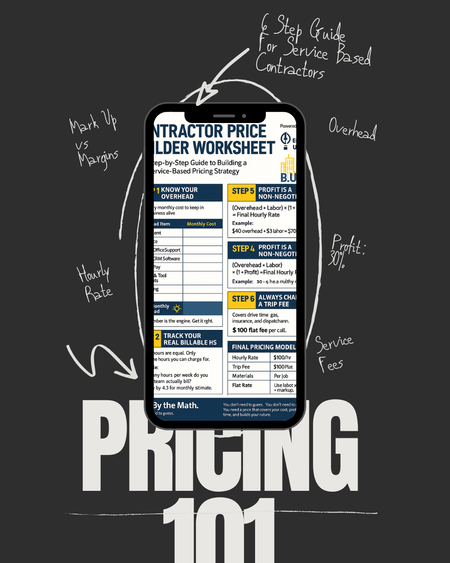
The number one question I receive is tied directly to the fact, most contractors are still guessing when it comes to pricing. Overhead. Profit. Labor rate. Trip fees. They think just because they throw a number they hear their competitors use, thats all that they need. It may work, but how and what do you divide these funds is just as important for your business health. If you don’t know how to do the math, you’re not building a business. You’re surviving check to check and think you need more work, when you do not. So here’s the plan: This Tuesday & Thursday on IG, I’m walking you through our Contractor Price Builder Worksheet FREE on instagram live. We will cover: - How to calculate your real hourly rate - The difference between markup and margin - Why profit is a non-negotiable - And how to price with confidence Join the session. Bring your numbers.1.7KViews3likes23CommentsWhat marketing channel works best for you right now???
Hello, We are currently evaluating our marketing strategy to improve lead consistency and build deeper community trust. While we currently use Yelp, we find the results inconsistent and often attract price-shoppers rather than long-term clients. :( Moving forward, I would like to pivot our focus toward community-based marketing, such as sponsoring local schools and Little League teams. These sponsorships build the kind of long-term goodwill and trust that ensures local homeowners think of us first during emergencies. To clarify our strategy, we are avoiding the following channels: - Lead Aggregators (Angi, Networx, HomeAdvisor): These platforms sell the same lead to multiple contractors. The requirement to respond within seconds to avoid losing the job—while still being charged—does not align with our workflow. - Yelp for Major Projects: Due to high cost-per-click metrics and a high volume of price-sensitive inquiries, we find this to be a low-return channel for larger plumbing jobs. Your Friendly Neighborhood Plumbers,360Views3likes15CommentsWhen is it time to hire an accountant?
I am wondering at what point some of you guys have hired an accountant? Did you hire one to grow? To maintain what you have? Or are you simply using one to file taxes at the end of the year? I am thinking about hiring an accountant to manage my finances for me and see where things go, but wondering when is the right time.238Views2likes2CommentsHow can service businesses automatically add late fees or interest to overdue invoices?
Does anyone know how to add auto interest or late fees to invoices? Considering the scope of my work this would be real handy when my average invoice payment time is around 50 days. Because of this I have to finance my own payroll and if I could recoup some of these interest charges automatically. Too many invoices to manually add fees1.1KViews2likes7Comments
What's the best way to do job costing?
Hello everyone, I have been inconsistent with adding expenses to each job. How are other jobber users adding expenses to each job to see your profitability per job? Are you having your techs keep track of parts/fittings used on a separate form and then adding that to the job after the job has been completed? Trying to find an easy way to keep track of this and get it entered into jobber. Thanks Ernie447Views2likes9CommentsHow do you scale past $1 Million in revenue? What are some common bottle necks to avoid?
Scaling past $1 Million has been one of the biggest challenges for me as a business owner. I'm curious what steps did you take to get over that hump and what advice do you have to get there?966Views2likes16Comments