How do contractors price jobs based on actual business costs instead of competitor rates?
We run a contracting business in Juneau, Alaska. It’s a remote town with no roads in or out, so our market does not work like most places. Lead generation is not our problem. The work is there. Our bigger challenge is filtering demand, choosing the right jobs, and pricing from the actual cost of running the business instead of just asking, “what does everyone else charge?” That has changed how we look at pricing. Two companies can do the same job with completely different numbers behind it: equipment payments, fuel, insurance, payroll, repairs, debt, admin time, material costs, disposal, taxes, and risk. Competitor pricing matters, but only to a point. If our cost structure is different, their price can’t be our whole pricing strategy. We have a CPA and bookkeeper we trust, so the books are not something we’re guessing on. What we’re working on now is turning the P&L and balance sheet into real-world pricing decisions: what the equipment needs to bill, what materials need to carry, what minimums make sense, and which jobs are actually worth putting on the schedule. We’ve also been using AI to organize that information into pricing structures, quote templates, equipment rates, per-ton pricing, material pricing, and job-type frameworks. To be clear, we’re not using AI to tell us what to charge. We’re using it to organize what we already know, pressure-test assumptions, run simulations, and find holes before they show up in the bank account. The more we work through it, the more we wonder how often underpricing comes from not having a clear link between pricing and the actual cost of running the business. Curious how others think about this. When you price work, do you start with your own numbers first, the market first, or a mix of both? For those using AI, have you used it for pricing, estimating, job costing, or financial review beyond emails and marketing content?93Views2likes8Comments
Do you know your actual effective hourly rate per client — once travel time is included?
Hi everyone — I'm a developer, not a cleaning business owner, so I'll be upfront about that. I'm doing early research before building anything. I've been spending time in this community and something keeps catching my eye. There are a lot of conversations about pricing, undercharging, and knowing your numbers — but the specific gap I keep noticing is this: Jobber shows you revenue per job, but it doesn't tell you your real effective hourly rate per client once you factor in drive time and how long a job actually ran versus what you quoted. For a residential cleaning business with recurring clients, that seems like it could matter a lot. The client who pays $200 but takes 45 minutes to drive to might look identical in Jobber to a client who pays $180 and is 5 minutes away. My question, specifically for cleaning business owners using Jobber: is this actually a problem you run into? Are you tracking profitability per client in any way right now — spreadsheet, gut feel, something else? And if you're not tracking it, is that because it's genuinely not a priority, or because there's no easy way to do it inside Jobber? Not selling anything — I haven't built anything yet. I'd genuinely love to have a 15-minute conversation with a few people who manage recurring residential clients in Jobber. Happy to share what I learn with anyone who's interested. Drop a comment or DM me.58Views1like1CommentHow can I create an invoice for the deposit?
When doing certain commercial work the client will ask us to send them an invoice for the deposit. This isn't typically how Jobber works as the invoice isn't created until the job is closed usually. What is the best way to send a customer an invoice before having the quote signed, deposit paid, or the job completed? Hope that makes sense. Thanks in advance!331Views1like10CommentsHow do you calculate delivery fees?
Gas prices are going up drastically!! When should we make the jump to increase delivery fees? Our customer base already complains about delivery fees because we are in the firewood market with a lot of our competitors not being official businesses, they usually just sell wood from their backyard so they are not concerned with overhead. How do you calculate delivery fees? Has anyone ever done a gas surcharge to introduce a hopefully temporary additional charge while prices are high?73Views0likes2CommentsHow Much Should You Really Be Charging?
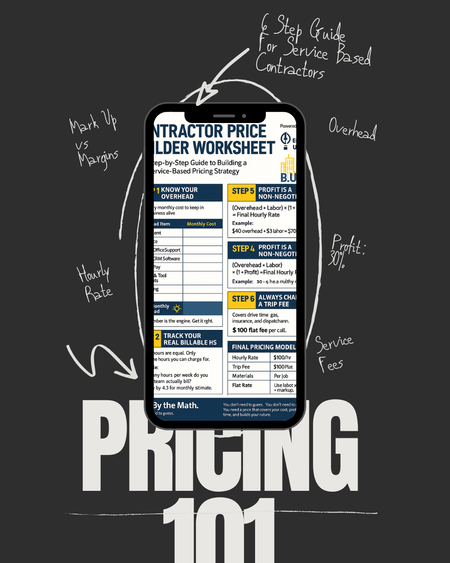
The number one question I receive is tied directly to the fact, most contractors are still guessing when it comes to pricing. Overhead. Profit. Labor rate. Trip fees. They think just because they throw a number they hear their competitors use, thats all that they need. It may work, but how and what do you divide these funds is just as important for your business health. If you don’t know how to do the math, you’re not building a business. You’re surviving check to check and think you need more work, when you do not. So here’s the plan: This Tuesday & Thursday on IG, I’m walking you through our Contractor Price Builder Worksheet FREE on instagram live. We will cover: - How to calculate your real hourly rate - The difference between markup and margin - Why profit is a non-negotiable - And how to price with confidence Join the session. Bring your numbers.1.2KViews3likes23CommentsHow do I record payment when a customer has already given me a deposit?
I am charging a customer $120/month for exterior rodent control and they paid me in full for the year. I applied that payment to the account but when I try to record each months service off of the credit, I can't seem to be able to. Jobber is telling me that the invoice must exceed $0.50. The balance is showing on the account but I can't figure out how to make the monthly charge come off of the balance. HELP!25Views0likes0CommentsWhen should businesses increase prices to keep up with rising payroll costs?
When's the last time you updated your pricing model to match your payroll reality? For example, our direct payroll (before tax) is 38% while our indirect payroll is 10%. As of January 2, we increased rates for all recurring clients by 4% to offload the indirect percentage. Going forward, we increased all first-time services by 5%. Thoughts?169Views3likes3CommentsDo you feel confident in your pricing?
Pricing can feel tricky. How do you usually decide what to charge? And what’s one thing you learned the hard way about pricing? In this episode of Masters of Home Service, Wilson Betances (EnergizeUs) shares: The 30-30-30-10 profit formula How knowing your true costs changes everything Why even a 5% price increase can have a big impact on profit Never miss an episode of Masters of Home Service. Subscribe on Apple, Spotify, or wherever you get your podcasts. 139Views0likes2Comments
Should service businesses use debt to grow and scale, or stay debt-free?
How do you view using credit lines, vendor lines of credit, credit cards, and loans to grow your business? If you prefer to grow debt free what is your strategy? What do you think are the pros and cons of each?321Views1like6Comments