Should you pause ads when you’re short-staffed?
I don’t think the answer is always to shut everything off. But running ads like normal when your team is already stretched can create a mess fast. More leads don’t help much if response times slow down, quality slips, routes get overloaded, or the owner has to jump back into the field to save the schedule. When we’re tight on capacity, I’d rather adjust the ads than pretend nothing changed. That could mean lowering the budget, keeping branded search on, focusing only on dense route areas, pushing new jobs further out, or temporarily stopping low-margin one-time work. Marketing should match capacity. If the ads are bringing in work the team can’t serve well, the campaign might look good on paper while the customer experience gets worse. But the other side is maybe this is the perfect time to hire and be over capacity instead of scrambling. When you’re short-staffed, do you pause ads, reduce spend, or keep leads flowing?99Views3likes5CommentsAre You Selling Your Service… or Selling the Experience?
Customers have more choices than ever. Sometimes the difference isn’t just the service you provide, but how you make people feel from the first interaction to the final follow-up. What are some ways your business creates an experience that keeps customers coming back?332Views2likes6CommentsFinding the Right Price: How Do You Charge Fairly While Still Making a Profit? As A Small Business
One of the biggest challenges for many small business owners is knowing how to set prices. You want to be fair to your customers while also making sure your business is profitable and sustainable. How do you determine what to charge for your services? Do you base your pricing on time, materials, competition, experience, or your desired profit margin? What advice would you give to a new business owner who is trying to find the right balance between being affordable and making sure they are not undercharging themselves?Solved255Views1like5CommentsAre reviews more useful than a marketing agency?
I’ve been thinking about this a lot lately. A good marketing agency can absolutely help a business. They can help with creative, targeting, campaigns, landing pages, reporting, and getting ads in front of the right people. But before you pay someone to write your message, it’s probably worth asking: Have you actually studied what your customers already said about you? Because your reviews may be one of the most useful marketing assets in your business. A lot of owners look at reviews as proof. 5 stars. Good testimonial. Nice thing to put on the website. That’s useful, but it’s only the surface. The better part is the language. Customers will tell you exactly why they hired you, what they were afraid of, what they noticed, what made them trust you, what almost stopped them from buying, and what made them stay. For us, reading through our reviews changed how I thought about our marketing. Customers kept repeating things like: “worth every penny” “one less thing to worry about” “like clockwork” “they text before they come” “they send a picture of the closed gate” “they take the waste with them” “I was embarrassed” “my last company left the gate open” “there aren’t enough hours in the day” That language is better than anything I could have guessed from sitting at my desk. It showed me the real buying triggers. Some people hired us because the yard got away from them over winter or they're busy families who didn’t have time. Others had health issues, pregnancy, injuries, or physical limitations. A small handful switched from cheaper competitors because they were tired of missed visits, poor communication, or gates being left open. Those details matter. If I only market the task, I sound like every other company. “We scoop dog poop.” That’s true, but it doesn’t explain why someone is willing to pay a premium. The reviews showed us what people actually valued: Communication. Reliability. Thoroughness. Gate safety. Waste hauled away. Professional scheduling. No judgment when the yard is bad. A clean yard without having to think about it. That becomes ad copy, website copy, quote follow-up language, sales training, social proof and also helps with pricing objections. When customers repeatedly say “worth every penny,” “more than fair,” or “I’d pay twice as much,” that tells me price is not the full story for the right buyer. It tells me I need to explain the value better, not panic and discount the service every time someone asks about price. A marketing agency can miss that if they don’t understand the business deeply enough. They may write clean copy, but clean copy doesn’t always match the customer’s internal conversation. Your reviews give you that conversation. They tell you what people were already thinking before they bought or what made them feel safe enough to hire you. They show you which parts of the experience matter more than you realized. For us, gate photos became a bigger marketing point because customers kept mentioning them. Hauling waste away became a bigger marketing point because customers kept comparing that to companies that leave it in their trash can. Communication became one of our strongest selling points because people brought it up over and over again. That’s the kind of information every business owner should be paying attention to. Before you rewrite your ads, rebuild your website or hire someone to "fix your marketing", read your reviews. Print them out. Tag the repeated phrases. Look for patterns. Group them by pain point, objection, trust factor, and reason they stayed. Then use the customer’s language in your marketing. Your best customers are often telling you exactly how to sell to more people like them. Have you ever gone through your reviews and pulled out the exact phrases customers keep repeating?71Views1like1CommentWhat marketing tool has given you the best return on investment?
Hi everyone! 👋 As a newer business owner, I'm trying to be intentional about where I invest my time and money. There are so many marketing tools available—from social media and Google Business Profile to vehicle wraps, yard signs, email marketing, referrals, and automation—that it can be hard to know what really works. If you could recommend just one marketing tool or strategy that has brought in the most customers for your business, what would it be and why? I'd love to hear what has worked for you and what you would recommend to someone just getting started. Thanks in advance for sharing your experience!268Views1like8CommentsWhat Automated Follow-Up Campaigns Should Home Service Contractors Set Up to Get More Repeat Business?
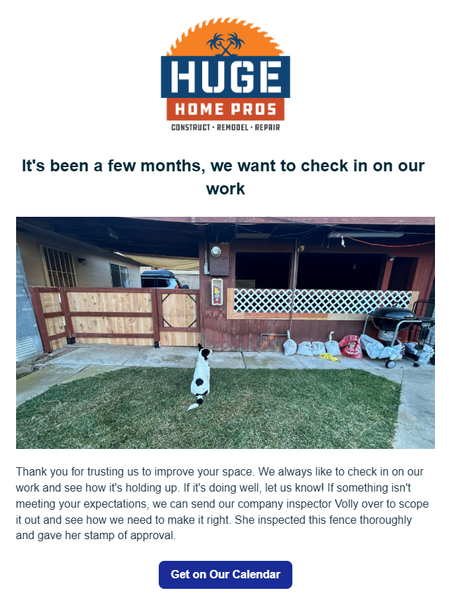
Hey guys! For those of you that have access to the marketing suite - there's a few things you can set up today, that will pay off as long you have it active. 1st - Check in on your work 2-3 months after it's done. This timeline is what I'm using for our type of projects so yours could be sooner. A lot of contractors will do a project then never reach out to the home owner again. I can't tell you how many jobs we've received just because we had this automation set up. In the settings you just set it up for XX amount of months after the invoice is paid. 2nd - Ask them for a referral. This isn't asking for a review. That's a given. But you want to be asking home owners if they have any friends that could use your services. Jobber actually has a referral tracking system integrated in it as well. I will say that people are a lot more motivation to refer when there's a benefit to them. Personally, I don't think it's valuable to just offer $$ off your own services. I think you need to give them something they can use anywhere. Just my opinion. Set this up for 1 week after your job is finished/ invoice paid. 3rd - Set up a 1-2 year sequence of emails. You could set one up for one a week. 2 a month. The main thing is you want to show up in their inbox every week. You know those brands that you are too lazy to unsubscribe to so you see them in your email? Ya, be more like them. This can take some time but start out by giving them a monthly email, then start to add to it. It can be the same nurture sequence for anyone that gets added. How do you not be annoying? Make it more about education than selling them a service. Have AI come up with something for your industry and just make some time every week to chip away at it. Over time this will pay off. And i's a set it and forget it type thing that can have a massive long term impact in your business.49Views2likes1CommentWhat Marketing Actually Works for Outdoor Service Businesses During Slow Seasons?
I run a small land clearing/brush clearing business in Ohio, and with how wet it’s been in our area lately, things are starting to slow down a bit. I’m trying to be proactive and focus on marketing so I can keep work coming in and continue growing the business. For those of you who’ve been in a similar spot, what marketing has actually worked best for you to bring in more customers and keep jobs lined up? Facebook ads, Google ads, yard signs, referrals, local networking, something else? I’d especially love to hear what’s worked well for seasonal or outdoor service businesses when weather starts affecting the schedule. Appreciate any advice or ideas you’re willing to share.173Views3likes5CommentsIs your follow-up helping you close, or annoying your leads?
This is one I had to learn the hard way. Speed-to-lead matters. If someone fills out a form, asks for a quote, or reaches out with interest, the business that responds fast usually has the advantage. A fast response can be the difference between closing the job and losing the customer to the next company they call. Quote reminders matter too. People get busy. They forget. They compare options. They need a little nudge. A good follow-up system can recover a lot of sales that would have gone cold. But there’s a point where follow-up stops feeling helpful and starts feeling pushy. That line matters. I learned this lesson from my only 1-star Google review. It wasn’t because of the service or because we did a bad job scooping. It came from a lead who didn’t want to receive any more messages, and because of technology issues with our automations, messages kept going out after they should have stopped. That one stung because it was preventable. It also taught me that automation can make you look organized when it works, and careless when it doesn’t. A follow-up system should never make someone feel trapped in your sales process. If a lead says they’re not interested, asks you to stop, or opts out, that needs to be respected immediately. No excuses. No “just one more reminder.” No system glitch that keeps poking them after they already said no. For us, that means paying closer attention to: how many quote reminders go out how close together they are what the wording sounds like whether the lead has a clean way to opt out whether the automation actually stops when it should whether a real person needs to step in before another message goes out The goal of follow-up is to reduce friction, not create resentment. A good reminder should feel like: “Hey, just checking in in case life got busy.” A bad reminder feels like: “Why won’t you answer me?” That difference affects your brand. Especially in local home services, where trust matters. People may not remember every detail of your quote, but they will remember if you made them feel pressured, ignored, or annoyed before they even became a customer. I still use automation. I still believe in follow-up. I still think most businesses lose money because they don’t follow up enough. But now I also think your follow-up system needs brakes. It needs opt-outs. It needs timing rules. It needs limits. It needs someone checking that the customer experience still feels human. Because closing more jobs doesn’t matter if the process damages your reputation with the people who don’t buy. How many times do you follow up on a quote before you stop? And do you have a clear opt-out process for people who don’t want more messages?245Views5likes11Comments