Are You Building a Business or Just Creating Yourself Another Job?
It’s easy as a small business owner to get caught up doing everything yourself. At what point do you start delegating, hiring, or putting systems in place so the business can operate without you being involved in every job? I’d love to hear how other owners are making that transition while still keeping quality and customer service high.223Views1like5CommentsWould you fire a difficult customer even if they spend a lot?
I have this one custome who is very very supportive of what I do but can be very difficult ALL THE TIME, even when I do every thing the way he likes it its never up to par and there's always something thats wrong. It can be difficult at times specially when Im pressed for time and have other customers waitingSolved337Views1like12Comments
$100K lesson - What contract language protects contractors when hidden conditions change the scope of a renovation job?
Hey all, first post. I'm Chad, founder of Great Raven Renovations Ltd. We're based on Salt Spring Island, BC, and run renovation, roofing, decks, and structural work across Salt Spring, the Cowichan Valley, and South Nanaimo. Started the company in January 2022 after walking away from a stable off-island job rather than compromise how I wanted to work. Almost four years in now. Has been a hard, useful run. The reason I'm here: most of what I've learned came the expensive way. Over those years I've put well over $140,000 into building this business — and lost more than $100,000 of it. Failed hires who couldn't hold a craftsmanship standard. Clients who exploited weak contract language to underpay or walk on finished work. Each one left a mark. What changed isn't that we got smarter on people — it's that we built a system around the kinds of losses that almost killed the company. A few of the pieces that came directly out of disputes: Hidden-conditions clause in the master contract. Written after a project where opening a wall doubled the real scope and the client refused to acknowledge it. Signed change orders with price and schedule impact before work happens. Written after a job where verbal "just add this" requests turned into three weeks of unpaid labour. Before/during/after photo record on every job, including substrate conditions. Written after a homeowner claimed two months post-completion that something was never done — when in fact it was, and we had nothing to prove it. Completion walkthrough before the final draw is invoiced. Written after a final-payment dispute that should have been a 10-minute conversation on site. One accountable point of contact (me) instead of a rotating dispatcher. Written after we tried it the other way and watched communication fail in real time. None of that came from a course. It came from losses. The process exists because of disputes, not in spite of them. Curious how others here handle this — specifically the hidden-conditions problem. On older island homes we open walls and find things nobody could have priced. What language are you using in your contracts to protect both you and the homeowner when the unknown shows up? Anyone landed on wording that actually holds when a client pushes back? Appreciate the community. Looking forward to learning from you. — Chad Great Raven Renovations Ltd. Salt Spring Island, BC170Views0likes3CommentsWhat's Standard Gross Profit for Your Industry?
I once listened to Tom Reber preach about 50% gross profit and how if you aren't aiming for that, you are going to hurt yourself short/ longer term. He was basically saying, for every dollar you make, you need to make two. This has been super impactful for me and my business but I'm noticing on my really big projects, it's so hard to keep that. I have one $120k exterior BBQ that has definitely had some inefficiencies but we are probably looking at 35% end of day. But that's 35% of a large $$ so that is kind of ok. For those of you who do a good job tracking this (btw Jobber's gross profit calculator is objectively amazing for this btw)- what is your gross profit and what do you usually shoot for?148Views0likes1CommentYou Don’t Have a Lead Problem You Have a Follow-Up System Problem
You’re not losing jobs to competitors you’re losing them in your follow-up. Most HVAC businesses I’ve seen don’t have a lead problem… they have a system problem: missed calls, no follow-ups, and zero tracking. The ones scaling consistently are doing 3 things right: Capturing every lead in a CRM Automating follow-ups (SMS/email) Running simple local campaigns that bring repeat jobs Curious what system are you currently using to track and convert your leads? If you’re open, I can share a simple setup that’s working for other contractors.246Views2likes4CommentsWhen is it time to hire an accountant?
I am wondering at what point some of you guys have hired an accountant? Did you hire one to grow? To maintain what you have? Or are you simply using one to file taxes at the end of the year? I am thinking about hiring an accountant to manage my finances for me and see where things go, but wondering when is the right time.251Views2likes2CommentsReal Reason Most Contractors Don’t Know Where the Leak Is (How to Price)
Just returned from the Masters of Home Service Podcast with Adam and we broke down something every contractors pain point... Most of us think our pricing problem is about charging more. But in reality, it’s about not knowing where the leak is. That’s why I built the Pricing Blueprint Worksheet, it forces you to look at every category inside your business: Is your hourly cost set right? Is your team milking jobs or burning hours? Is your overhead eating too much of your margin? Are your profit targets too low? Or are you just lost trying to figure out where it all goes? When you separate these categories, you finally see where your money ends up. You’ll know if it’s a labor problem, an overhead problem, or a leadership problem. This is exactly what we talked about on the podcast, that transition from employee mindset to owner mindset. Thank you Jobber Team for the opportunity. Here is the sheet we went over and let me know your thoughts.263Views1like2CommentsWe’re In Q3 — How Are Your 2025 Goals Holding Up?
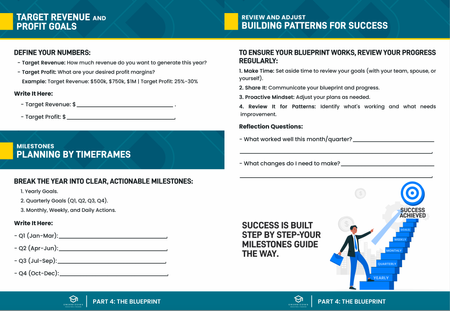
Now that we’ve officially entered Q3… I’m checking in: • Are you where you thought you’d be by this point in the year? • What worked well in the first half? • And what needs to be tweaked so you don’t coast through summer? For us, we’re doubling down on and been using this visual from our Blueprint Series to stay focused each quarter: Would love to hear from others: What’s one change you’re making to finish Q3 strong?125Views0likes0Comments