When Should You Fire Your SEO Agency?
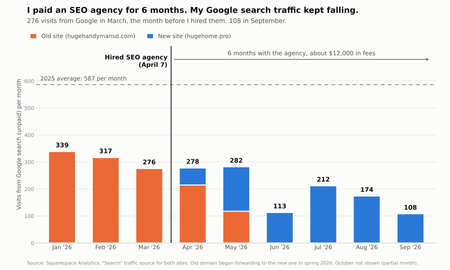
We all want our websites to rank better, and to show up on maps. Once you have the budget, it CAN be a good idea to get a marketing agency to handle SEO for you. I made this move 7 months ago and just fired mine and I'll tell you why. First and foremost, I don't claim to be an SEO wizard. The Jobber podcast has had some amazing episodes on this over the last year, people giving hints on how to improve your rankings etc. I followed all their advice and was experiencing a steady level of traffic but I was ready to super charge my efforts. I hired a company that had a great reputation in another coaching group, and they seemed pretty legit. The promise - $1500/ month for 3 service pages, 5 back links, and meetings every month to go over progress. I thought it'd especially be important because we had just rebranded and I wanted to make sure our traffic stayed up. This was the result: From what I can tell, you have to give companies as least a few months to do their magic. Also, google took away the Call button which attributed to less phone calls. But although it made me feel secure to have someone "handling" our SEO, the results spoke for themselves. Much less traffic. From what I can tell, our high review traffic was doing a lot of the heavy lifting. Claude would analyze their work and the impact of the back links didn't seem to be there and we can make our own service pages with actual pictures vs the stock ones they were using. So we made the decision to move on and do the work ourselves with Claude. What have your experiences been with SEO companies? Have you had success with any? What were they doing?10Views0likes0Comments
What’s Actually Working for Marketing in 2026? 🚜📈
Trying to figure out what actually works for marketing a small service business in 2026 feels like throwing darts blindfolded sometimes. 😅 Facebook boosts? Marketplace? Reels? Before & after photos? Community groups? Google Business? Word of mouth? Door hangers? I run a veteran-owned rural property management company in New Brunswick, Canada, and I’m curious what’s genuinely bringing people, real customers lately — not just likes and views. For the people actually getting calls and booked jobs: • What’s been your most successful marketing approach? • What gives the best ROI for a small budget? • What completely flopped for you? • Are you finding people respond more to personality/branding or straight-up service ads and pricing? Would love to hear real experiences from other small business owners and operators. 🚜🔥133Views0likes3CommentsHow much Quote Follow Up is Too Much?
"Can you turn off my automations, your system is blowing me up?" I've gotten that a lot the last few months since I've set my system up. We basically text and email at day 1,2,3, 6,8,12,16,20,25,29 after the quote is sent unless they give us a "no". I feel like it can go two ways. The people that are going to accept but haven't gotten around to it are annoyed by it. The people that aren't going to accept usually don't say anything. I do get a "no" about day 12 though. The others, no response either way. What kind of nurture sequence are you guys setting up and how successful is it?323Views0likes11Comments
Short videos for getting more leads – what is working for you?
Curious how other home service businesses are using short videos for marketing. Before/after clips, quick walkthroughs of a finished job, or a 15-second "meet the crew" video seem to work well on Facebook, Instagram and Google Business Profile, but making them consistently takes time. Some owners are starting to use AI video tools to turn job-site photos and a short script into a video, for example Nereo. I think that can help with volume, but real footage of your own team probably still builds more trust with homeowners. What has worked for you: phone videos, hiring someone, or AI tools? And which platform actually brings in quote requests?131Views0likes4Comments
What are you doing right now to make the phone ring for your business?
what is your go to advertisements or sales tactics to get lead generation? We have been in business for over 17 years now servicing the Tampa bay area and this year has hit us the hardest. I am an isa certified arborist and I do engage in networking and community events but despite our best efforts we are still experiencing a lack of leads. I don't want to just throw money at the wall but we are running out of options. what are some things that are working for you?672Views1like9CommentsAt what point do you hire an agency?
I'm at the point in my business where I really need to not be doing stuff that I'm not good at and I have enough money to invest in different areas of the business to improve the operations. I'm actually rebranding as well so I'm changing our website then it got me thinking - My old website was good, I put a lot of work in to the back links, SEO optimizing it myself, but it does look a little DIY. I got to thinking, this would be a good time to do it correctly and potentially have a professional do it, and maybe I've been missing out on potential traffic because of the website. Has anyone hired an agency with success? What about failures? What things should I be thinking about when approaching this?451Views1like10Comments
Tips for collecting onsite social media content from my crew?
Does anybody have any tips to motivate/energize my crew to take photos, record videos, etc onsite that we can then use to create content for our social media pages? I haven't started asking them to do it yet, but I want to see if anyone has any success stories from their fields.196Views1like6CommentsAt What Point Does “More Revenue” Stop Being the Goal?
As business owners, we’re constantly encouraged to grow. More clients. More employees. More service areas. More revenue. But eventually, growth comes with more management, more overhead, more complexity, and sometimes… not that much more profit. We’ve hit points in our business where the question shifted from “How do we make more?” to “How do we make what we already have work better?” Better margins. Better clients. Better systems. Better retention. More revenue per client. Less dependence on the owner. I think there’s a huge difference between growing a business and just making a business bigger. For those of you who have been at this for a while: how do you decide when to keep pushing for revenue growth versus optimizing the business you already have? And has anyone intentionally decided NOT to grow past a certain size?123Views0likes2Comments